Italiano
 English
 Français
 Deutsch
The "vase" and its design possibilities |
| "Vase" designs can be of great interest due to the many solutions that can be found, thanks to their simple and humble function: containing flowers, a branch, or ... nothing. |
|
The decorative part is very stimulating: One can act not only on the decorative aspect but also on the form and marvel at how a simple object can become an inexhaustible source of study. The designer can in this way play on the harmonic relationships, on the finishes, on the colors, as well as on the stories that can be born from each of them, enriching them without making them seem unfairly of objects of second order. The peculiarity of the "vase" object is that it can be made of many materials: glass, ceramic, metal, wood, plastic. Of course some materials suits some project bests, or rather they can enhance its peculiarities better: the "Patch" vase I designed for "Salviati" would not make sense if it were produced in another material other than Murano glass: the "patches" of glass applied to the hot vessel when it’s still attached to the barrel and superimposed between them without forming any bubbles (thanks to the previous jacketing phase), are nothing more than the result from trials and failures that went on for months during the production procedure.
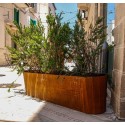
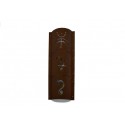
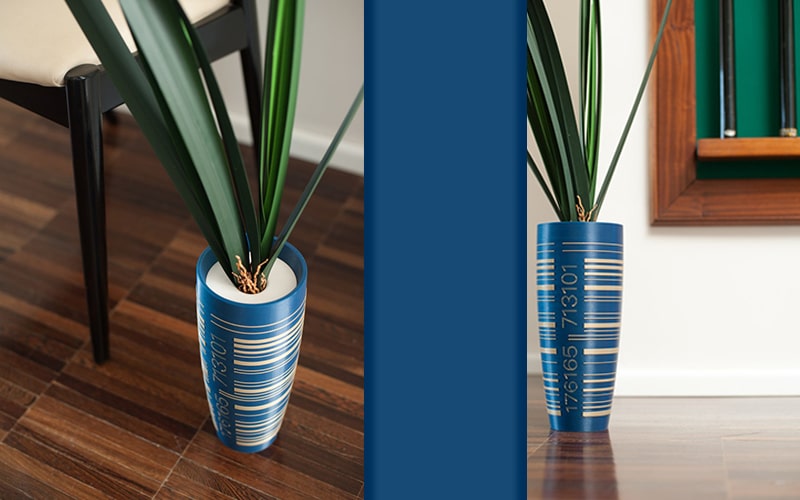
Other vases were made of plastic for "Eumakeit" through the use of the compatible bio filament for 3D printers of "Eumakers", a company very sensitive to the issue of sustainability (thanks to the use of non-toxic materials). This process gives the possibility to see the product realized shortly after having designed it, making any further improvement and calibration phase easier. Another interesting project is the one designed for "TrackDesign": a metal vase, or better a "corten" one. This is not a vase aimed at containing a plant, but it has a exclusively decorative use. "Incastro", this is the name, and it comes from the interlocking of two sheets of different height that give a play of shadows. Compared to other materials, corten steel requires a bigger design effort, thanks to its being monochromatic. With glass and plastic, you can "play" easily with colors, making it the most cheerful and captivating object; but when it comes to corten it is important to act even more on the proportions and the change of plans, perhaps using shutters to create shadows. This project was then developed further and with some changes turned into an atypical umbrella stand, by means of providing it with hidden holes for ventilation and an internal tray for collecting water, which is easily removable through a vertical rod. A parallel work to the design concerns the search for the name to be given to the product: many times it recalls its characteristic, as in the case of “Incastro” or “Doppio Taglio”, other times from a pun (eg the plastic vase is called "Cab", since its decoration recalls a bar code, with the relative succession of numbers).
The couple of vases "Toso and Tosetta" it’s their shape that recalls a couple of lovers who look at each other tenderly or, turning slightly, ignore themselves as if they were annoyed. The "Patch" vase is inspired by Arlecchino's dress, while "Cecè" by a character from a comedy by Pirandello, a famous Italian writer. A further study on the logos associated with each product is also related to this search, if we consider graphics as an excellent and stimulating parallel design exercise, as the great Carlo Scarpa used to do for his architecture.
Edited article Giancarlo porti |


Articoli Correlati
- Pensiline Fotovoltaiche per aziende: la soluzione smart per energia e spazio
- Tendenze design 2026: la rivoluzione degli interni tra metallo e autenticità
- Pensiline fotovoltaiche in corten: design ed energia e contributi fino al 65% per le aziende
- Case in acciaio: il futuro dell'architettura tra design e sostenibilità
- Facciate ventilate e rivestimenti in lamiera metallica